PL EXIT SIGNS IN SMOKE

LL sign in smoke

I’ve been corresponding with Mike Shulman, Principal Engineer, Lighting at UL in Fremont California. My discussion focussed on a number of topics but let’s look at visibility in smoke.

I asked for Mike’s comment on this statement: A PLM exit sign does not work in smoke conditions and smoke is a foreseeable circumstance.

Mike’s response:

No exit signs work in smoke. Smoke creates two concurrent conditions: first, it scatters all light making any exit sign just a faintly glowing object with no discernible legend or image. Second, it is an extreme irritant to the human eye and makes it virtually impossible to keep your eyes open at all (resulting in no visibility whatsoever). Smoke filled rooms and hallways can generally only be traversed by getting very low to the ground where, for a period of time, the smoke layer may not be complete. Floor proximity luminous path markings are the preferred tool to assist with building evacuation where smoke is likely to occur during the process.

It’s interesting that the Lighting Cartel look to propose more and more luminance to solve a problem that could be solved very easily with a low level photoluminesent sign.

ECOGLO EXIT SIGNS IN UNION STATION

Union Station pic 2

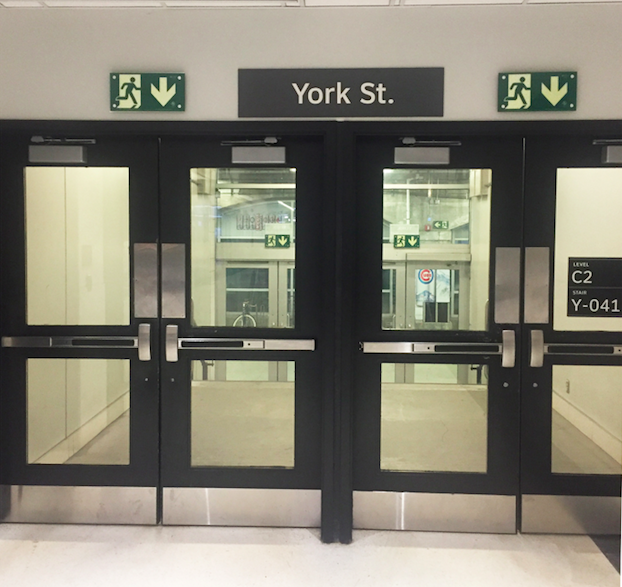
Having been in Toronto last week it was great to walk through Union Station a number of times and see Ecoglo’s photoluminescent exit signs throughout – 2,400 installed so far with more to come as redevelopment continues.

It was an easy choice for the facility’s operations team. It’s not that often that you can make a significant step forward in sustainability while saving a bucket load of money – and all building code compliant.

Very straight forward and simple – unless you’re just trying to make it very complicated.

FANTASTIC LIGHTING COUNCIL SOMERSAULT – DID YOU SPOT IT?

Screen Shot 2018-07-17 at 11.09.01 AM

I’ve seen some pretty good somersaults in my time from some real experts but when I read the Lighting Council’s latest Illuminations newsletter I was impressed.

It described a private dinner with Minister Craig Laundy whose ministry is responsible for the Australian Building Codes Board.

I wonder whether Minister Laundy spotted the quick flip the Lighting Council had to make to get to being a bastion of innovation and market choice with this:
“The 2019 draft NCC has a number of especially concerning provisions that will have the effect of significantly and unnecessarily reducing the range of lighting equipment that can be deployed in the built environment.”

When in the previous paragraph their position was this:
“The dinner provided an opportunity for Lighting Council to brief the Minister directly on industry’s concerns about the 2019 draft of the National Construction Code (NCC) and the use of photoluminescent exit signs.”

In my opinion it makes sense if the “industry’s concerns” are looked at in the context of the impact on their members’ margins and profits. This of course means facility managers and the property sector in general pays more.

The fact that USA, Canada, Japan and New Zealand all have building code provisions for photoluminescent exit signs to replace battery back-up exit signs seems to have escaped the Lighting Council – or possibly that’s what their real concern is?

FOR EVERY SOLUTION THERE’S A PROBLEM – LURKING IN THE BACKGROUND

Old Batteries lo res

I read in the Manufacturers’ Monthly that Lighting Council Australia is relaunching Exit Cycle, a recycling program to improve “the recycling rates of emergency and exit lights.”

This looks like some progress as now at least there’s acknowledgement that a problem exists.

The article states that “there are approximately 30 million emergency and exit lights” in Australia and “the majority of the green-emergency lights we see across all buildings are powered by a combination of older battery technologies, which often use cadmium, nickel metal hydride or sealed lead acid”, (“green-emergency lights” – is that a bit of greenwashing?).

I wonder where all those batteries and the e-waste from failed exit signs are going now?

The obvious solution is to get rid of batteries and e-waste forever by using more photoluminescent exit signs and emergency visibility products.

But then there’s the little issue of all that turnover generated by servicing and replacing 30 million fittings ie don’t kill the goose, we want facility managers to keep laying the golden eggs.

WHEN IS HALF THE TRUTH A WHOLE LIE?

Screen Shot 2018-06-02 at 1.05.52 PM

Benjamin Franklin is quoted as saying “half the truth is often a great lie”.

I think the “great” referred to the size of the lie rather than the quality but you do see a lot of effort going into constructing a pretty good lie hidden behind a little bit of fact.

The Lighting Cartel in Australasia have been peddling a number of half truths as they battle to retain relevance and their self appointed “gate keeper” position.

Both the Australian and New Zealand building codes have been updated to recognise that traditional electrical emergency lighting and toxic battery back up exit signs are NOT the only one way to provide emergency visibility and identify exits.

Since modernisation of the building codes we have seen propaganda and half truths peddled around the industry inferring that AS 2293 is the only way to provide emergency visibility and exit signage that is compliant with the building codes. Complete RUBBISH!

In my opinion AS 2293 is a standard that is demonstrably flawed and outdated but the incumbent committee, having ruled the roost for so many years, seem to be able to ride roughshod over Standards Australia’s published Standards Guidelines.

I think it’s time we started to call out the half truths.

If there’s interest out there we’ll start a series of brief posts pointing out some of these technical constructs and leave it to you to decide if what’s true and what’s not.

I don’t want to waste my time so hit me with a “like” if you think this is a good idea – or if you’d like to keep it off the grid simply send me an email: td@ecoglo.com

PROBLEMS WITH OUTDOOR EMERGENCY LIGHTING?

180523 Outdoor Emergency Lighting

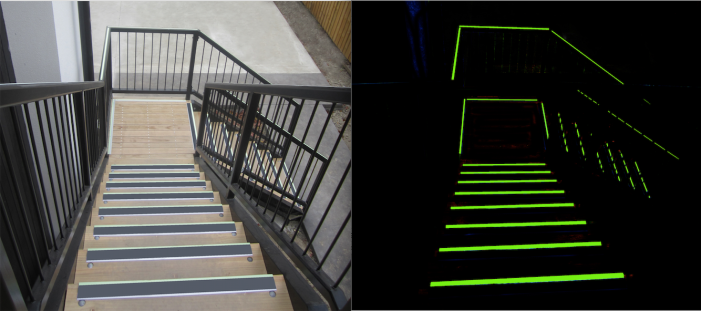
Outdoor stairways are difficult and expensive to light and traditional emergency lighting is particularly problematic. Ongoing maintenance issues drive up operating costs so that’s where Ecoglo’s emergency visibility products can build a failsafe code compliant solution. It’s Ecoglo’s durability in outdoor conditions that really makes the difference.

Ecoglo’s engineers are continually approached to create emergency lighting solutions for outdoor stairways which are part of an evacuation route or exit path and now a recent engineering report confirms just how effective Ecoglo’s solution is, complete the form below if you’d like more information.

Ecoglo products absorb natural light during the day and then are visible all night.

Cost effective, failsafe, sustainable.

http://www.ecoglo.com
http://www.ecoglo.com.au
http://www.ecoglo.co.nz

← Back

Thank you for your response. ✨

WHY IS THE LIGHTING CARTEL IN AUSTRALIA SQUEALING SO MUCH? #$$$$$$$$$

160301 $ Bag Graph

I’ve had a number of reports about the pressure being applied to building surveyors, certifiers and fire engineers by the lighting cartel in Australia. It appears that they don’t like photoluminescent exit signs which are compliant building code solutions in USA, Canada, Australia, New Zealand and Japan! The activity seems so orchestrated that you’ve got to wonder what’s behind it all?

The lighting cartel bleats on about “public safety being paramount” but is that the real reason they’re applying so much pressure to design and compliance professionals?

I think it’s the old “follow the money”. How many PL exit signs have we sold in NZ since the building code was changed? If the saving per sign is $150 we’re talking about many, many millions of dollars missing out of some poor emergency lighting sales manager’s budget.

When we get the same market penetration in Australia there will certainly be blood on their balance sheets, very sad 😦

The lighting cartel can keep going with their theatrics but every day we see more facility managers, consultants and regulators shaking their heads in disbelief, they know the huge dollars that the cartel are trying to protect.

ECOGLO PL HYBRIDS IN THE BONAVENTURE HOTEL

The Bonaventure Hotel in downtown Montreal is an architectural gem with over 400 rooms and suites – not to mention excellent views of the gardens and city.

To make sure that the hotel’s exit signs will operate in any blackout the Bonaventure has installed Ecoglo’s revolutionary hybrid PL exit signs which combine state of the art LED technology with Ecoglo’s patented photoluminescent technology. No more battery failures or generators failing to start, not to mention big savings in facility operating costs!

Ecoglo’s technology essentially replaces the battery or generator with a photonic storage device – the Ecoglo photoluminescent panel. The Ecoglo hybrid PL exit signs use the panel to store the photonic energy from the built in LED’s (which are powered from mains electricity).

If the electricity fails in an emergency the stored energy in the Ecoglo panel is used to produce visible light.

This means no more battery failures and no need to find someone else’s backyard to dump the old batteries in.

Cost effective, failsafe, sustainable!

For a technical data sheet email Trevor: td@ecoglo.com